
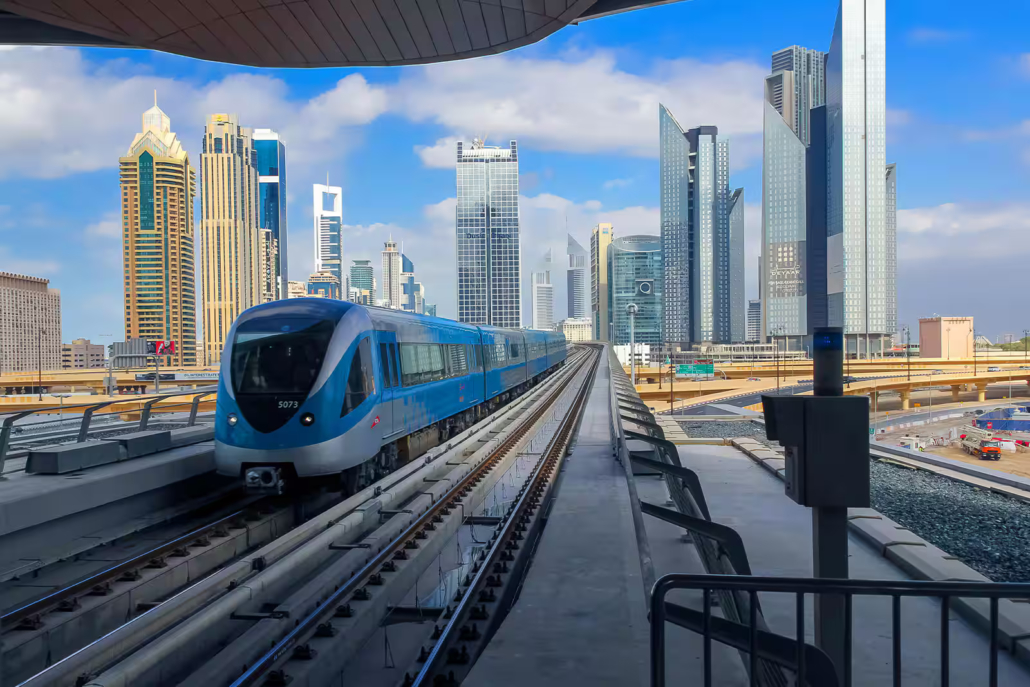
Elastomeric Bridge Bearings for the Dubai Metro
5 Key Advantages of Elastomeric Bridge Bearings in the Dubai Metro
The Persian Gulf has established itself as the epicenter of the world’s most cutting-edge road and rail infrastructure projects. Building on the success of previous projects in the region, Cacesa once again demonstrated its international leadership by supplying elastomeric bridge bearings for the Dubai Metro—specifically for the well-known Orange Line.
This bridge elastomeric bearing project marked a new milestone in our export history, reinforcing the confidence that major engineering firms place in our structural guidance and damping solutions.
The Dubai Metro: World-class elevated infrastructure
Dubai’s urban design stands out for its modernity and its pursuit of efficient mass transit solutions. As is the case with the world’s most advanced metro projects, a large part of its route was designed using elevated viaducts above ground level.
This aerial configuration presents a critical technical requirement:
-
Rail support: The beams supporting the train tracks must rest on flexible elements.
-
Load isolation: Concrete piers and columns require an interface to absorb dynamic impacts from the continuous passage of vehicle convoys.
To address this situation, our elastomeric bridge bearings were installed on a large scale, serving as the ideal transition element to ensure the safety of the entire metro line.
Technical challenges and piece-by-piece certification
Supplying components for a public transport project of this magnitude entails the utmost responsibility. A large-volume order for the Dubai Metro tests not only the factory’s physical production capacity but also its quality control systems.
The main challenge of this project lay in the need to guarantee and individually certify each of the supports supplied. At Cacesa, every batch destined for critical infrastructure undergoes a rigorous verification process that checks:
-
The perfect adhesion between the rubber and the internal steel plates (vulcanization).
-
The exact resistance to vertical compressive forces.
-
The geometric flexibility required to absorb thermal expansion caused by the desert climate.
Engineering and collaboration with the domestic sector
One of the highlights of our involvement in the Dubai Metro is the channel through which the project was managed. Once again, the trust placed in us by a specialized engineering firm based in Spain was the key that opened the doors to the United Arab Emirates.
The ability of national technical teams to engage in direct, peer-to-peer dialogue greatly facilitates the design of elastomeric bridge bearings that align precisely with project blueprints. Engineering firms choose Cacesa not only for its competitive pricing but also for its technical competence in producing the documentation and quality certifications required by local governments in the Gulf.
EN 1337 Standard and CE Marking in the United Arab Emirates
Although the project is located outside Europe, the technical requirements in Dubai align with the strictest international standards. Consequently, all our supplies were designed and tested in accordance with the EN 1337 standard.
Compliance with this standard and the corresponding inclusion of the CE mark ensure that the elastomer used will maintain its mechanical properties intact over the long term. In an environment where the temperatures of asphalt and concrete structures undergo extreme thermal fluctuations between day and night, the quality of the rubber compound is the only factor preventing catastrophic structural failures.
Conclusion: Proven reliability in extreme climates.
Cacesa’s presence on the Dubai Metro’s Orange Line confirms that our elastomeric bridge bearings are the ideal solution for projects demanding flawless performance under harsh weather conditions and heavy usage. We continue to connect cities and secure the future of transportation through precision rubber engineering.


Leave a Reply
Want to join the discussion?Feel free to contribute!