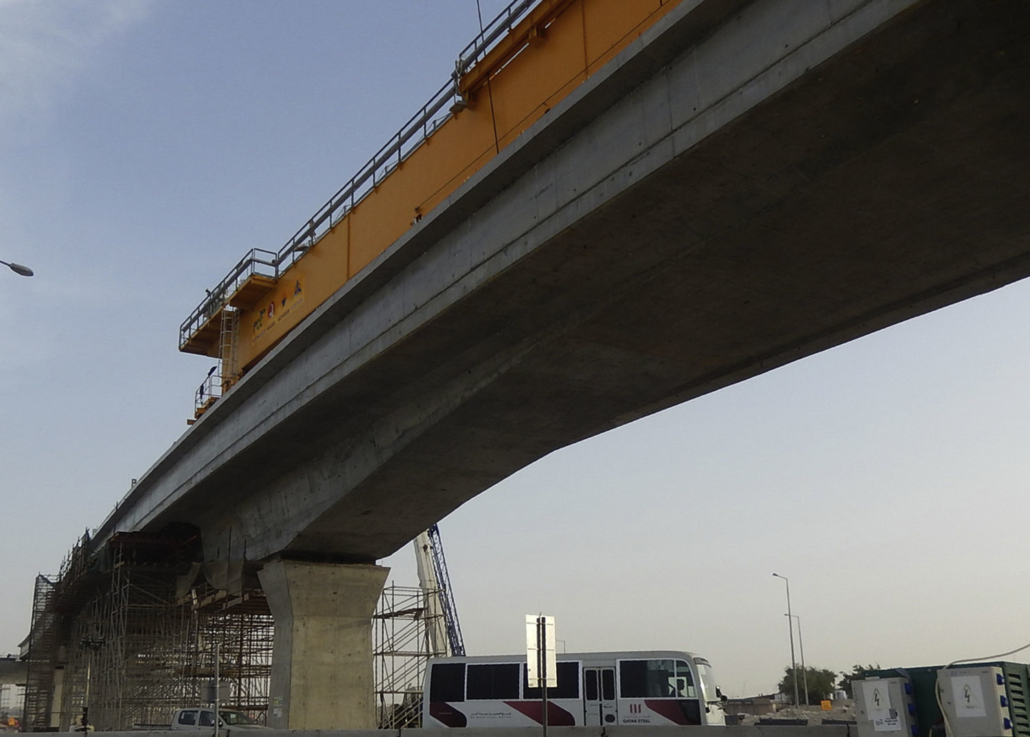
Elastomeric bearings are essential structural elements in the construction of bridges, viaducts, and buildings subjected to dynamic loads. Their main function is to transmit loads between the superstructure and the substructure, while simultaneously allowing for rotational and translational movements generated by thermal effects, shrinkage, creep, or seismic loads.
These devices are composed of layers of vulcanized elastomer, with or without internal steel reinforcement sheets, depending on the type of support required (simple elastomer, with internal plates, or fretted neoprene supports). The design complies with regulatory requirements such as UNE-EN 1337-3 and must guarantee:

Resistance to aging, ozone, oils and UV rays.

Ability to withstand high vertical loads without permanent deformation.

Predictable behavior under horizontal and rotational stresses.

Durability in extreme weather conditions and continuous exposure to cyclic stress.

In modern structural analysis, elastomeric bearings allow for greater design flexibility while reducing stress on other structural elements. Their correct sizing and installation are critical to preventing long-term structural problems.
Innovation in elastomeric compounds, along with controlled manufacturing processes, allows manufacturers like Cacesa Rubbers to offer reliable technical solutions tailored to the specific requirements of each project, including certification, traceability, and rigorous regulatory compliance.

Marcado ce en apoyos elastoméricos

The True Difference Between EN 1337 and CE Marking for Elastomeric Bearings

The True Difference Between EN 1337 and CE Marking for Elastomeric Bearings

Compliance with European standards is an essential requirement for any manufacturer of civil infrastructure components. In this conversation with David, we clarify one of the topics that raises the most questions among technicians and clients: the interrelationship between the EN 1337-3 standard, laboratory testing, and obtaining the CE mark for elastomeric bearings.

Definition of the raw material: The EN 1337-3 standard

To begin the discussion, the requirements of the regulations regarding the base materials used to manufacture rubber and steel bearings are addressed.

— Regarding any of these projects, what are the differences between the standards being met—EN 1337 and CE marking—or how do they work?

— Well, regarding standards, the primary requirement is compliance with the EN 1337 standard. Why? Because it defines a set of characteristics that the raw materials used to manufacture the bearings must meet. Specifically, EN 1337-3 dictates the use of steel and rubber with certain specified properties—materials that are already in use.

So, simply by using the materials involved—rubber and natural rubber—you have already defined the EN 1337 standard.

The practical test: What does CE marking really add?

This section of the interview details the direct relationship between theoretical regulatory compliance and physical accreditation through technical testing.

— What does tagging add?

— Well, in addition to meeting those requirements, you conduct tests to certify compliance. So, by certifying that the materials meet the technical specifications indicated by the CE marking, you obtain the mark itself.

However, there is no difference in terms of materials between a bearing that complies with the standard and one that bears the marking. There are simply tests confirming that it does indeed comply with EN 1337, and that is what enables the bearing to carry the CE marking.

Aclaración de conceptos y laboratorios de ensayo

The speaker summarizes what David has presented to confirm the distinction between raw materials and samples, leading into an explanation of how Cacesa manages quality testing at its facilities.

— If I’ve understood correctly, the materials themselves fall under the EN 1337 standard, and to obtain the CE mark—which stands for European Economic Community—you have to conduct tests to prove that everything works as intended.

— The tests you described are carried out by you at the very factory you have for that purpose. While you sometimes send them to an external laboratory if requested, you do have your own lab to apply the required markings to the parts that meet the standards.

— The marking requirement obliges you to undergo an annual external audit by the certifying company, which verifies that you have the necessary records, have conducted the required tests, and so on.

The accreditation process step by step

As David explained during the conversation, obtaining the CE marking for elastomeric bearings requires a methodology in which quality is not taken for granted but is continuously demonstrated.

1. Material selection according to EN 1337-3

The starting point is to use steels and rubber formulations that comply with the specification tables of the European standard. Without the appropriate raw materials, it is not possible to move towards certification.

2. Tests in in-house or external laboratories

To obtain the CE mark for elastomeric bearings, manufactured units must undergo mechanical testing. Cacesa has itsown laboratory to validate the units’ compression and shear parameters, while retaining the flexibility to use accredited external laboratories when project specifications require it.

3. External audit and annual traceability

CE marking is not merely a static label, but a dynamic system. An external certification body conductsperiodic annual auditsof the factory to review:

  • The raw materials logbook.

  • Test reports from laboratory testing

  • The proper functioning of the factory production control (FPC) plan.

This continuous guarantee is what enables Cacesa to offer a fully certified, highly reliable product for bridges, viaducts, and metro systems anywhere in the world.

Normativa en 1337 para apoyos

EN 1337 Standard for Elastomeric Bearings and CE Marking

EN 1337 Standard for Elastomeric Bearings and CE Marking

In the civil engineering and building sector, structural safety is an absolute priority. When designing and installing support elements in bridges, viaducts, or large structures, two fundamental concepts arise repeatedly: the EN 1337 standard for structural supports and CE marking.

Although they are often mentioned together, many engineering and construction professionals wonder: what are the real differences between them? How do they complement each other in the manufacturing process? In this article, we answer all your questions about quality control for these critical components.

1. The EN 1337-3 standard: The basis of the raw material

The first pillar of quality is the EN 1337 standard for bearings, specifically Part 3 (EN 1337-3), which strictly regulates elastomeric bearings. This European standard defines in detail the technical characteristics and physical properties that all raw materials used in manufacturing must meet.

Features regulated by the standard:

  • Rubber and elastomers: Establishes the thresholds of elasticity, resistance to aging, Shore hardness and behavior under extreme temperature variations.

  • Steel plates: Defines the steel grades and thickness tolerances that the internal metal plates that are vulcanized inside the elastomer must have.

By using the appropriate materials according to these standards, the support implicitly meets the requirements of European regulations. However, the standard alone only defines the material theory; a further step is needed to ensure its validity in practice.

2. The CE Marking: Certification through physical testing

This is where the CE marking (European Conformity) comes into play. In terms of materials, there is no physical difference between a support that simply meets the standard and one that bears the CE mark. The fundamental difference lies in the demonstration and verification.

The CE marking is the system that officially certifies that these materials meet all the specified technical characteristics in practice. To obtain this mark, it is mandatory to carry out a series of physical and mechanical tests on the finished parts.

Where are the control tests performed?

At Cacesa, we have our own laboratory equipped with specialized machinery to perform the compression, shear, and quality control tests required for CE marking. Although clients or project management sometimes request that tests be sent to accredited external laboratories for greater impartiality, having in-house capacity significantly speeds up turnaround times.

The role of annual external audits

Obtaining CE marking is not a one-time procedure. It is an ongoing commitment to quality that requires strict production control.

To maintain the European conformity mark for supports under the EN 1337 standard, manufacturers must undergo an annual external audit. During this process, an independent certification body reviews:

  1. Manufacturing records: Complete traceability of every batch of rubber and steel used.

  2. Test history: Reports of mechanical tests performed in our laboratory to verify that the properties remain stable.

  3. Internal processes: The correct calibration of vulcanizing presses and measuring equipment.

Conclusion: Guaranteed safety from theory to practice

In summary, while the EN 1337 standard for bearings establishes the mandatory technical parameters for rubber and steel, the CE marking is the physical and unequivocal proof that these standards have been met through actual testing and under the control of external audits. At Cacesa, this double quality filter is what allows us to offer maximum peace of mind to the engineering firms that rely on our structural solutions for national and international projects.

Apoyos para puentes y viaductos

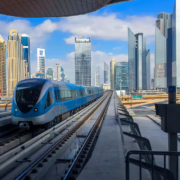
The Supply of Supports for Bridges and Viaducts in the Dubai Metro

The Supply of Supports for Bridges and Viaducts in the Dubai Metro

Bridge and viaduct supports. The expansion of transport networks in the United Arab Emirates has demanded the highest level of expertise from industrial component suppliers. In this new interview with David, head of Cacesa, we analyze firsthand the details of the supply and certification of the damping systems used on the Dubai Metro’s Orange Line, a project that consolidates our track record in the international rail sector.

The context of the project: High-speed infrastructure in the United Arab Emirates

To understand the scale of the project, it’s necessary to analyze the type of route this mass transit system follows. Below, Pedro and David detail the physical characteristics of this metro network and how the structural solution was developed in Spain.

— There’s another metro project you’re working on that I’d like to ask you about now, which is the Orange Line of the Dubai Metro. In the other project, you built a viaduct; here, the metro line itself is also a bridge so the trains run above it. Tell us a little about its exact location and what kind of infrastructure it is.

— Well, as Pedro has already told you, this is the Dubai Metro. I’m not entirely sure if it was a metro line, though; I remember it being the orange line, and it’s somewhat similar to what was done in Doha. They’re elevated bridges, I think I remember a section of them, and that’s where the supports are used to hold up the beams that support the train tracks—the pillars.

The technical solution: Exclusive elastomeric supports for the Dubai Metro

In regions with desert climates, the simplicity and high strength of the materials are key factors in avoiding complex maintenance in the future. This section confirms the unique solution adopted for the bridges on the line.

— In this case it’s the same as the other one, I suppose the solution you’re providing is elastomeric supports and there’s no other material.

— That’s right, what we do in these countries is supply elastomeric bearings for bridges, and yes, they placed the order with us. Again, it was through our engineering firm in Spain, which specialized in these countries and was kind enough to place the orders with us.

The challenge of quality management: Individualized certification

The real challenge of “pharaonic” projects in the Persian Gulf usually lies in the strict levels of control demanded by international organizations and the engineering firms in charge of supervising the work.

— Well, it was a very large order with the technical complications that entails, so in order to guarantee and certify each and every one of the supports we have provided.

Technical analysis: The value of piece-by-piece certification

As David rightly points out in the conversation, the scale of an order for supports for bridges and viaducts intended for a metro network lies not only in the physical volume of vulcanized rubber that is manufactured, but also in the destructive and non-destructive quality control that is applied to each unit.

What does certifying each and every support entail?

To meet engineering deadlines and current regulations, the manufacturing process for bridge and viaduct supports at Cacesa’s facilities must follow very strict automated protocols:

  1. Compression tests: Each piece is subjected to simulated loads equivalent to those that the real subway pillars will withstand with the trains at full capacity.

  2. Vulcanization control: It is checked that there are no air bubbles or imperfections in the joint between the internal steel plates and the elastomer.

  3. Full traceability: Each of the supports for bridges and viaducts leaves our facilities with a unique serial number and its corresponding technical test sheet, something vital for the Spanish engineering team to validate the installation for the end customer in Dubai.

Thanks to this methodological rigor, the components supplied by Cacesa continue to ensure the stability and correct guidance of the rails in the most modern metro lines in the Middle East.

Apoyos elastoméricos para puentes

Elastomeric Bridge Bearings for the Dubai Metro

5 Key Advantages of Elastomeric Bridge Bearings in the Dubai Metro

The Persian Gulf has established itself as the epicenter of the world’s most cutting-edge road and rail infrastructure projects. Building on the success of previous projects in the region, Cacesa once again demonstrated its international leadership by supplying elastomeric bridge bearings for the Dubai Metro—specifically for the well-known Orange Line.

This bridge elastomeric bearing project marked a new milestone in our export history, reinforcing the confidence that major engineering firms place in our structural guidance and damping solutions.

The Dubai Metro: World-class elevated infrastructure

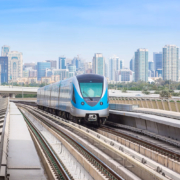
Dubai’s urban design stands out for its modernity and its pursuit of efficient mass transit solutions. As is the case with the world’s most advanced metro projects, a large part of its route was designed using elevated viaducts above ground level.

This aerial configuration presents a critical technical requirement:

  • Rail support: The beams supporting the train tracks must rest on flexible elements.

  • Load isolation: Concrete piers and columns require an interface to absorb dynamic impacts from the continuous passage of vehicle convoys.

To address this situation, our elastomeric bridge bearings were installed on a large scale, serving as the ideal transition element to ensure the safety of the entire metro line.

Technical challenges and piece-by-piece certification

Supplying components for a public transport project of this magnitude entails the utmost responsibility. A large-volume order for the Dubai Metro tests not only the factory’s physical production capacity but also its quality control systems.

The main challenge of this project lay in the need to guarantee and individually certify each of the supports supplied. At Cacesa, every batch destined for critical infrastructure undergoes a rigorous verification process that checks:

  1. The perfect adhesion between the rubber and the internal steel plates (vulcanization).

  2. The exact resistance to vertical compressive forces.

  3. The geometric flexibility required to absorb thermal expansion caused by the desert climate.

Engineering and collaboration with the domestic sector

One of the highlights of our involvement in the Dubai Metro is the channel through which the project was managed. Once again, the trust placed in us by a specialized engineering firm based in Spain was the key that opened the doors to the United Arab Emirates.

The ability of national technical teams to engage in direct, peer-to-peer dialogue greatly facilitates the design of elastomeric bridge bearings that align precisely with project blueprints. Engineering firms choose Cacesa not only for its competitive pricing but also for its technical competence in producing the documentation and quality certifications required by local governments in the Gulf.

EN 1337 Standard and CE Marking in the United Arab Emirates

Although the project is located outside Europe, the technical requirements in Dubai align with the strictest international standards. Consequently, all our supplies were designed and tested in accordance with the EN 1337 standard.

Compliance with this standard and the corresponding inclusion of the CE mark ensure that the elastomer used will maintain its mechanical properties intact over the long term. In an environment where the temperatures of asphalt and concrete structures undergo extreme thermal fluctuations between day and night, the quality of the rubber compound is the only factor preventing catastrophic structural failures.

Conclusion: Proven reliability in extreme climates.

Cacesa’s presence on the Dubai Metro’s Orange Line confirms that our elastomeric bridge bearings are the ideal solution for projects demanding flawless performance under harsh weather conditions and heavy usage. We continue to connect cities and secure the future of transportation through precision rubber engineering.

Apoyos estructurales de caucho

The Challenge of Manufacturing Structural Rubber Supports for the Pepa Bridge

The Challenge of Manufacturing Structural Rubber Supports for the Pepa Bridge

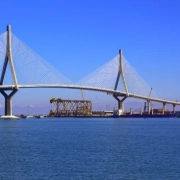
Rubber structural supports. In this new installment of our talks with the Cacesa technical team, we speak with David about one of the most demanding road infrastructure projects in the country: the supply of structural supports for the 1812 Constitution Bridge in Cádiz, a project that challenged the limits of our production capacity due to the colossal size of its components.

The Pepa Bridge in Cádiz: A unique cable-stayed structure

— Let’s talk now about another of the infrastructure projects you’ve built: the Puente de la Pepa in Cádiz, Spain. The Puente de la Pepa is the bridge commemorating the Constitution of 1812. It’s a cable-stayed bridge that crosses the Bay of Cádiz and provides access to the city from the mainland, serving as the third access point. For this bridge—here in Spain it’s easier to understand, we all know where Cádiz is, or it’s easier to locate—what type of structure is it? It’s a bridge, but what solution did you use? Supports? Joints? What did you solve, or what product did you use, to build this Puente de la Pepa in Cádiz?

— Yes, indeed, we worked as suppliers of components for the bridge, but always, as in this case, we also did so through another company, which happens to be the same one we discussed in the previous project. But yes, we focused solely on the structural supports, the pillars, the bridges; we didn’t supply any of the other elements because, well, cable-stayed bridges do have fewer supports than other bridges, and, well, it was a special case that our client was handling, so we simply provided what they requested.

Technical challenges: Manufacturing and vulcanizing 3,500 kg rubber structural supports

— The same question I was asking you: have there been any challenges with this project, any technical problems related to heavy loads or because it’s a cable-stayed bridge, such as lateral movement instead of just weight? Any technical problems that this project presented that you recall or that you see as different from other projects?

— Yes, indeed, on this occasion I was very aware of it, being close to the project and having to manufacture the structural rubber supports. Obviously, there were three of these supports, and they did present a technical challenge in terms of their size; that is, they were enormous supports that we had to adapt a bit to the machinery in order to work with them. I don’t remember the exact dimensions, but I do remember the weight of each support, which was around 3,000 or 3,500 kilos. So we had to handle such a large support, demold it, remove it from the press, and so on; prepare the loads… It was all a very complicated undertaking.

And besides that, being so large, we also had the problem that none of them could go wrong because, of course, if one of those supports came out wrong, the loss was all we could gain; in other words, it was a total loss. Therefore, we had to do it very slowly, positioning the plates very carefully, positioning the rubber very carefully, putting everything together perfectly, knowing exactly what vulcanization time it needed—which we also had no prior knowledge of—and so on. A series of technical challenges that we did manage to overcome, and thanks to, well, the time we’ve spent making the supports, the result was positive; they sold and are working without any problems.

Production capacity: Large format machinery for large parts

— And I’ll say the same to you: why CACESA? Why did they choose your suppliers? If it was, as you said, because of the price, the durability, the ability to manufacture custom-made products, because it complies with international regulations… What is the reason they chose CACESA?

—Well, in this case, the reason was more the characteristics of our machine than the price. So, besides… Our specialty is large pieces, as I mentioned in a previous audio recording. Our machines are large; to make these supports, you need a machine with certain dimensions… I remember the largest one where the supports were made, which is 2 by 2 meters, 2 meters wide and 2 meters long, and then, importantly, it opens a meter or a meter and a half wide. This allows you to insert the support, vulcanize it, work inside, and so on. So, in this case, the client chose us, apart from the price, delivery time, and so on, because the machine’s specifications were suitable for making the support.

Life cycle: Performance and behavior of long-term rubber structural supports

—Well, the bridge’s been built for a while now… Do you know how long it’s been built? It’s been quite a few years, hasn’t it? This bridge must have been around 2008, right? I mean, it’s been… Not quite 20 years, but maybe close. So, it’s a bridge that’s been built for some time now, and I’m asking you the same thing: are the supports working properly? Is the bridge still there? But do you have any kind of follow-up? Has the company, the engineering firm, told you anything? Do you have any contact with them from other projects? I don’t know if they tell you a bit about how the work turned out.

— Well, the truth is, no, we don’t know how they’ve performed… I mean, we know they work because otherwise, they would have told us, because these pieces have a long lifespan, and if they lasted less than that, the client would have let us know right away. But no, we don’t really monitor the work, and it’s true that we dedicate our time to new projects, to improving, and well, we try to do that. One of the most important things for us when it comes to running the company is that it’s essential for the piece we make to last in perfect condition for as long as possible, and with these supports, it’s true that we make a lot of them, and it’s working out well for us.

Apoyos elastoméricos a medida

Custom Elastomeric Bearings: Technical Solution for the Puente de la Pepa in Cádiz

Custom Elastomeric Bearings: Technical Solution for the Puente de la Pepa in Cádiz

Custom-made elastomeric bearings. The 1812 Constitution Bridge, popularly known as the Puente de la Pepa, is one of Spain’s most complex and spectacular engineering feats. As it is a high-rise cable-stayed bridge spanning the Bay of Cádiz, the selection of structural components was critical.

In this project, the use of large-format custom-made elastomeric bearings proved essential to manage massive loads and ensure the stability of this vital infrastructure that connects the city to the mainland.

The Pepa Bridge and the need for special support

This structure is the third access point to Cádiz and stands out as one of the tallest bridges of its kind in the world. Due to its cable-stayed design, the distribution of stresses differs from that of conventional viaducts. Although this type of bridge requires fewer support points, these must be capable of withstanding extraordinary stresses.

As specialized suppliers, at Cacesa we handled the custom-designed elastomeric bearings specifically for the structure’s pillars. The client, an engineering firm with whom we had already collaborated on international projects, trusted our ability to solve a challenge of extraordinary dimensions.

Challenges in the manufacture of large tonnage parts

The main challenge of this project was not only the chemical composition of the rubber, but also the physical size of the pieces. We are talking about supports that reached a weight of between 3,000 and 3,500 kilos per unit.

1. Handling and precision in vulcanization

Manufacturing custom elastomeric bearings of this weight requires highly sophisticated internal logistics. Because they are such massive blocks of rubber and steel, the vulcanization process is extremely delicate:

  • Heat management: It is necessary to ensure that the vulcanization temperature reaches the core of the part homogeneously without degrading the outer layers.

  • Plate precision: In pieces weighing more than three tons, the manual placement of the vulcanized steel plates must be perfect to avoid deviations in load capacity.

  • Production risk: Due to the cost of materials and the time invested, there was no margin for error; each piece had to be perfect the first time to meet profitability and deadline standards.

2. Large format machinery (2×2 meters)

The reason Cacesa was chosen for this project lies in our production capacity. Manufacturing these custom elastomeric bearings requires presses with dimensions that are not standard on the market:

  • Working surface: We have 2×2 meter machines that can accommodate the gigantic molds needed for the Puente de la Pepa.

  • Opening capacity: Our machinery allows openings of up to one and a half meters, facilitating the demolding and safe handling of 3,500 kilo pieces.

Bridge engineering and compliance with EN 1337 standards

The safety of an infrastructure that supports constant traffic to Cádiz cannot be left to chance. Therefore, all our custom-made elastomeric bearings are manufactured in accordance with the strict EN 1337 standard.

This European regulation guarantees that the structural supports have passed tests of:

  1. Compressive strength: Supporting the weight of the deck itself and the dynamic traffic loads.

  2. Rotation capacity: Allowing the structure to adapt to movements without generating cracks in the pillars.

  3. Durability in marine environments: The rubber is formulated to withstand the salinity and extreme humidity of the Cadiz coast.

Furthermore, the CE marking seal confirms that each unit delivered has passed rigorous quality controls, ensuring a lifespan exceeding several decades of flawless service.

Results after more than a decade of service

The Puente de la Pepa bridge is now a firmly established feature of the Cádiz landscape. After years of operation, the custom-made elastomeric bearings supplied continue to function without any technical issues.

In our philosophy as manufacturers, success is measured by the absence of any customer feedback: if the supports don’t require corrective maintenance before their expected lifespan, the work has been excellent. This project reinforces our specialization in large parts, where technical expertise and the right machinery make the difference between a standard component and a high-level engineered solution.

Conclusion: Leaders in tailored support solutions

Our involvement in the 1812 Constitution Bridge demonstrates that Cacesa is the ideal partner for projects where scale and technical complexity are critical. The supply of custom-made elastomeric bearings for this project is a testament to our ability to tackle monumental challenges with meticulous craftsmanship.

Proyecto metro de doha

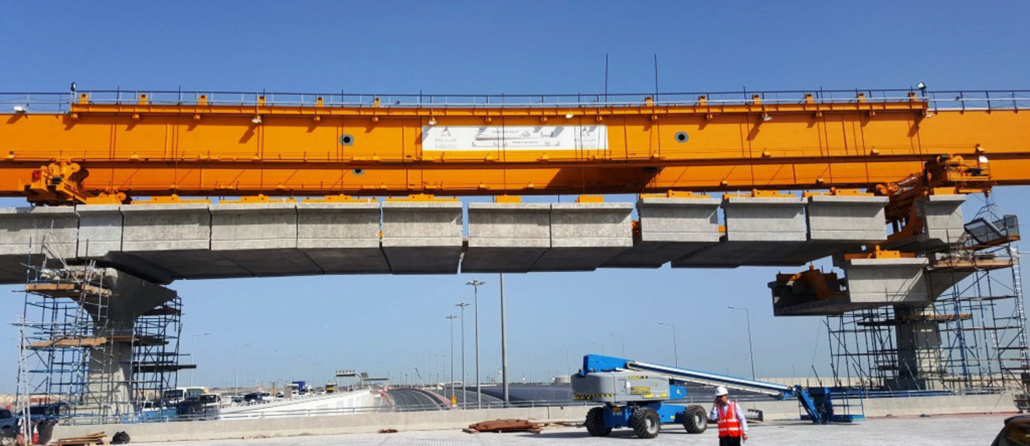
The Challenge of Supplying Elastomeric Supports in the Doha Metro

Doha Metro Project. Supports for Qatar Viaducts. In this installment of our technical talks, David joins us again to break down the details of one of Cacesa’s most emblematic projects: the Doha Metro viaduct in Qatar. A project that is celebrating its tenth anniversary and marked a turning point in our international expansion.

Origin of the Doha Metro project: Elevated infrastructure in the Persian Gulf

— Well, today we’re back with David to talk about Cacesa’s clients, the projects they have underway, and we’re going to start with some of the older ones, and then we’ll move on to others that are more recent. For example, today we’re going to talk about three. Today we have this one here in Doha, Qatar. You built a viaduct for the metro. What type of infrastructure is it, and where exactly is this metro located?

— Well, as Pedro says, we’re going to try to explain a little bit about these projects, which are important projects that have given us international recognition we didn’t have before. These projects were built years ago, at the beginning of the growth of the Persian Gulf countries, and to this day, at least ten years later, the elements that were sold at the time are still working perfectly.

So, to begin with, Pedro asks me about the Doha metro, in which, well, the infrastructure that was going to be built was a metro that went above the surface, so it had quite a few pillars that needed support and well, it was a fairly large project.

Technical challenges: Extreme temperatures and specialized rubber

— Regarding this project, do you recall any technical problems? I know you say you struggle with the business side, but we’ll add that when the engineer tells us more. But do you remember any technical issues like very heavy loads, seismic activity, extreme weather conditions with very high temperatures, or complex structural rotations? Is there any aspect of this project that particularly caught your attention?

— Well, the issue of working in high-temperature environments always forces us to use a type of rubber that is more suitable so that it can withstand the temperatures and technical characteristics that the supports have to endure, and so that it withstands them well.

So, the only technical problem I recall is that, defining a specific rubber compound that would work. These supports weren’t overly complex, as they were, if I remember correctly, C-type supports with a single plate where the elastomeric bearing rested, but they weren’t particularly difficult. In other words, what you’ve used here are only elastomeric bearings; there’s no expansion joint, no other product, just elastomeric bearings for this project.

Commercial Management: The connection with Barcelona Engineering

— I’m asking you, how did you get this client? How did they ask you to do something in Doha, a country far from here, that you have to go all the way to Qatar to set up a project? It could have been an American, a European, anyone, I suppose. How did they find you? Why did they choose you? What do they see in your materials that makes them better than others? Or why did they choose you in particular?

— Well, we’ve been working on this project for years to open up a market in the Persian Gulf through our sales team specializing in these countries, but actually, a supplier, an engineering firm from Barcelona, ​​approached us. They were the ones who put the project forward. They contacted us, and well, they decided to choose us. It’s the usual story: quality, service, price, the company’s good reputation, and our years of experience.

Logistics and deadlines in a “pharaonic” work of the Doha Metro Project

— You’ve already mentioned that this project could be there for about 10 years and I don’t know the final result. So, if you could tell me, has it been something special for you, a significant milestone, or is it more or less the same as your everyday work, but done outside your home country, outside of Spain? Or did you have to do anything special within the company itself? Did you have to modify anything?

— Well, from a production standpoint, it wasn’t a challenge, because as I said before, they’re simple supports to manufacture. What was a bit more complicated was meeting the delivery deadlines, which our client in this case was very demanding, because it was a massive project, with a huge number of supports, and they wanted them within a specific timeframe.

So we had to cover the financing, the collections, the payments, and then deliver on time all the supports we had to manufacture. And what’s wrong with this market? Well, precisely when it’s strongest is when everyone is on vacation, which is in August. So planning and organizing the operators’ schedules, the vacations, and serving the customer was more complicated than usual, due to the large number of supports.

The life cycle of supports and monitoring of the Doha Metro Project

— And regarding the follow-up, you tell me that you don’t do maintenance, that you only make the parts, you don’t have anything to maintain, but I don’t know if you have any kind of relationship with the clients, once the works are finished, so that they tell you how the work is going, how everything has gone, or do you simply when your work is finished you give it to the engineering and the engineering takes care of the rest.

—Well, normally when we supply the supports, which are components with a very long lifespan, we don’t track completed projects because we’re almost always the suppliers and not the ones carrying out the work. So, combined with the quantity and the lifespan of the component itself, we tend to lose track of how the projects have progressed. It’s true that we always have a reference project, but we don’t do any real monitoring.

Apoyos elastoméricos del metro de doha

Elastomeric Bearings for Viaducts of the Doha Metro

Elastomeric Bearings for Viaducts of the Doha Metro

The Doha Metro represents one of the most impressive milestones of modern engineering in Qatar. In a project of this magnitude, the choice of elastomeric bearings for the viaducts was no small matter. These components are responsible for absorbing structural movements and ensuring the safety of thousands of passengers daily.

In this article, we analyze how technical specialization and compliance with EN 1337 standards allowed this project to become an international benchmark of success.

The Doha Metro: A road infrastructure of monumental scale

Road infrastructure in the Persian Gulf presents challenges not found in Europe. The design of the Doha Metro, with its long elevated sections, demanded a support system capable of withstanding extreme conditions. Here, elastomeric bearings for viaducts act as the vital link between the decks and the structure’s piers.

Climate challenges at the Qatar viaduct

Building a viaduct in Qatar means subjecting materials to temperatures exceeding 50°C. This temperature range causes constant expansion in the concrete. To address this, a specific rubber compound was developed that maintains its elastic properties under scorching heat, ensuring that the supports do not crystallize or lose load-bearing capacity.

Elastomeric bearings for viaducts

Bridge Engineering: The Science Behind the Type C Bearing

In bridge engineering, the C-shaped bearing is recognized for its reliability. These devices incorporate vulcanized steel plates inside the elastomer, which allows for:

  1. Withstand massive vertical loads: Ideal for heavy rail traffic.

  2. Allow horizontal deformations: Absorbing the effects of the subway’s braking and acceleration.

  3. Compensating for rotations: Crucial when the viaduct crosses curves or uneven terrain.

The use of these elastomeric bearings for viaducts in Doha has shown, after 10 years of use, that durability is the best investment in maintenance.

Compliance with EN 1337 Standard and CE Marking

Safety in mass public transport leaves no room for error. Therefore, every unit manufactured for this project complied with EN 1337. This European standard is the most demanding in the world for structural supports, defining everything from the purity of the rubber to the strength of the steel sheets.

The CE Marking Guarantee

CE marking was a non-negotiable requirement for the Barcelona-based engineering firm that led the bidding process. This certification guarantees that the products have been laboratory tested under shear and accelerated aging conditions. For Cacesa, offering fully certified materials was the key that opened the doors to the Qatari market, giving them an edge over American and Asian competitors.

“Pharaonic” Logistics: Production under pressure

One of the key points of the interview with our technical team was the management of deadlines. In a project of this scale, the volume of elastomeric bearings for viaducts required was immense.

  • Intensive production: Special shifts had to be organized to meet the customer’s delivery dates.

  • Holiday coordination: Much of the manufacturing coincided with the month of August, which required masterful human resource planning.

  • Financing and Collections: An export project requires financial stability to manage cash flows while the material travels to the Gulf.

Gr16

Why does the Doha Metro remain a benchmark?

Today, the Qatar viaduct is an example of how Spanish industry can lead global projects. The key was not just manufacturing a component, but understanding the project’s ecosystem: the engineering needs, the demands of the climate, and the rigor of modern road infrastructure.

The lifespan of these components is extremely long, reducing the need for post-construction interventions. This is vital in elevated viaducts where access for replacing a support is costly and complex.

Conclusion: Quality that crosses borders

The successful supply of elastomeric bearings for viaducts on the Doha Metro confirms that the combination of EN 1337 compliance and logistical adaptability is unbeatable. At Cacesa, we remain committed to technical excellence to support the major infrastructure projects of the future.