
The Challenge of Supplying Elastomeric Supports in the Doha Metro
Podcast: Play in new window | Download
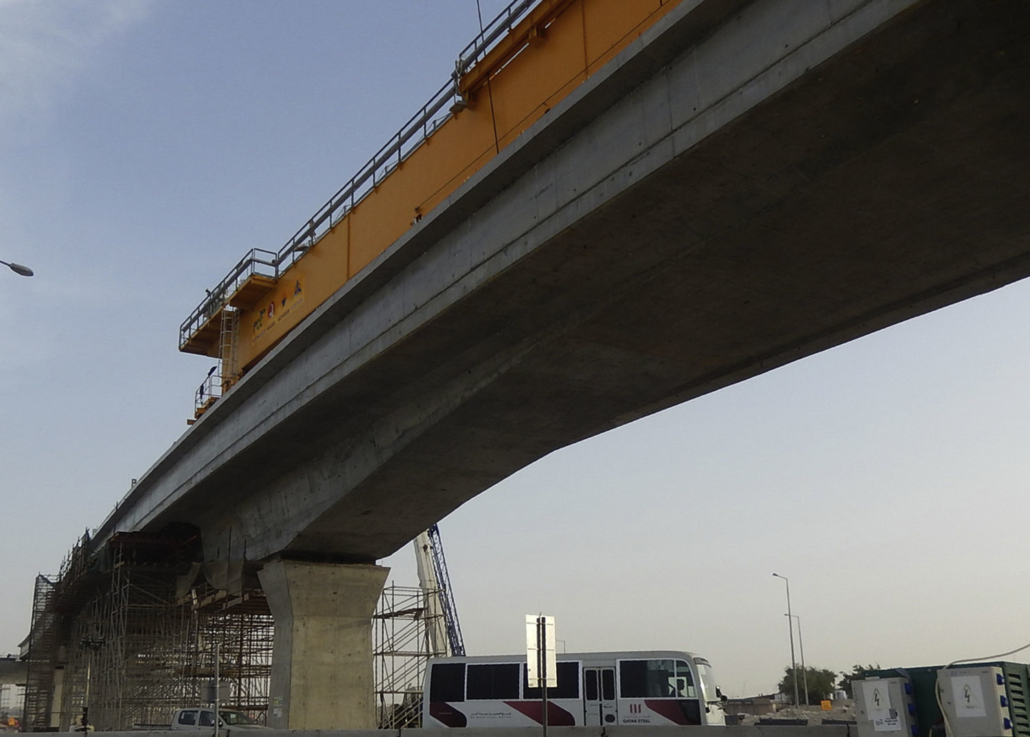
Doha Metro Project. Supports for Qatar Viaducts. In this installment of our technical talks, David joins us again to break down the details of one of Cacesa’s most emblematic projects: the Doha Metro viaduct in Qatar. A project that is celebrating its tenth anniversary and marked a turning point in our international expansion.
Origin of the Doha Metro project: Elevated infrastructure in the Persian Gulf
— Well, today we’re back with David to talk about Cacesa’s clients, the projects they have underway, and we’re going to start with some of the older ones, and then we’ll move on to others that are more recent. For example, today we’re going to talk about three. Today we have this one here in Doha, Qatar. You built a viaduct for the metro. What type of infrastructure is it, and where exactly is this metro located?
— Well, as Pedro says, we’re going to try to explain a little bit about these projects, which are important projects that have given us international recognition we didn’t have before. These projects were built years ago, at the beginning of the growth of the Persian Gulf countries, and to this day, at least ten years later, the elements that were sold at the time are still working perfectly.
So, to begin with, Pedro asks me about the Doha metro, in which, well, the infrastructure that was going to be built was a metro that went above the surface, so it had quite a few pillars that needed support and well, it was a fairly large project.
Technical challenges: Extreme temperatures and specialized rubber
— Regarding this project, do you recall any technical problems? I know you say you struggle with the business side, but we’ll add that when the engineer tells us more. But do you remember any technical issues like very heavy loads, seismic activity, extreme weather conditions with very high temperatures, or complex structural rotations? Is there any aspect of this project that particularly caught your attention?
— Well, the issue of working in high-temperature environments always forces us to use a type of rubber that is more suitable so that it can withstand the temperatures and technical characteristics that the supports have to endure, and so that it withstands them well.
So, the only technical problem I recall is that, defining a specific rubber compound that would work. These supports weren’t overly complex, as they were, if I remember correctly, C-type supports with a single plate where the elastomeric bearing rested, but they weren’t particularly difficult. In other words, what you’ve used here are only elastomeric bearings; there’s no expansion joint, no other product, just elastomeric bearings for this project.
Commercial Management: The connection with Barcelona Engineering
— I’m asking you, how did you get this client? How did they ask you to do something in Doha, a country far from here, that you have to go all the way to Qatar to set up a project? It could have been an American, a European, anyone, I suppose. How did they find you? Why did they choose you? What do they see in your materials that makes them better than others? Or why did they choose you in particular?
— Well, we’ve been working on this project for years to open up a market in the Persian Gulf through our sales team specializing in these countries, but actually, a supplier, an engineering firm from Barcelona, approached us. They were the ones who put the project forward. They contacted us, and well, they decided to choose us. It’s the usual story: quality, service, price, the company’s good reputation, and our years of experience.
Logistics and deadlines in a “pharaonic” work of the Doha Metro Project
— You’ve already mentioned that this project could be there for about 10 years and I don’t know the final result. So, if you could tell me, has it been something special for you, a significant milestone, or is it more or less the same as your everyday work, but done outside your home country, outside of Spain? Or did you have to do anything special within the company itself? Did you have to modify anything?
— Well, from a production standpoint, it wasn’t a challenge, because as I said before, they’re simple supports to manufacture. What was a bit more complicated was meeting the delivery deadlines, which our client in this case was very demanding, because it was a massive project, with a huge number of supports, and they wanted them within a specific timeframe.
So we had to cover the financing, the collections, the payments, and then deliver on time all the supports we had to manufacture. And what’s wrong with this market? Well, precisely when it’s strongest is when everyone is on vacation, which is in August. So planning and organizing the operators’ schedules, the vacations, and serving the customer was more complicated than usual, due to the large number of supports.
The life cycle of supports and monitoring of the Doha Metro Project
— And regarding the follow-up, you tell me that you don’t do maintenance, that you only make the parts, you don’t have anything to maintain, but I don’t know if you have any kind of relationship with the clients, once the works are finished, so that they tell you how the work is going, how everything has gone, or do you simply when your work is finished you give it to the engineering and the engineering takes care of the rest.
—Well, normally when we supply the supports, which are components with a very long lifespan, we don’t track completed projects because we’re almost always the suppliers and not the ones carrying out the work. So, combined with the quantity and the lifespan of the component itself, we tend to lose track of how the projects have progressed. It’s true that we always have a reference project, but we don’t do any real monitoring.


Leave a Reply
Want to join the discussion?Feel free to contribute!