
The Challenge of Manufacturing Structural Rubber Supports for the Pepa Bridge
Podcast: Play in new window | Download
The Challenge of Manufacturing Structural Rubber Supports for the Pepa Bridge
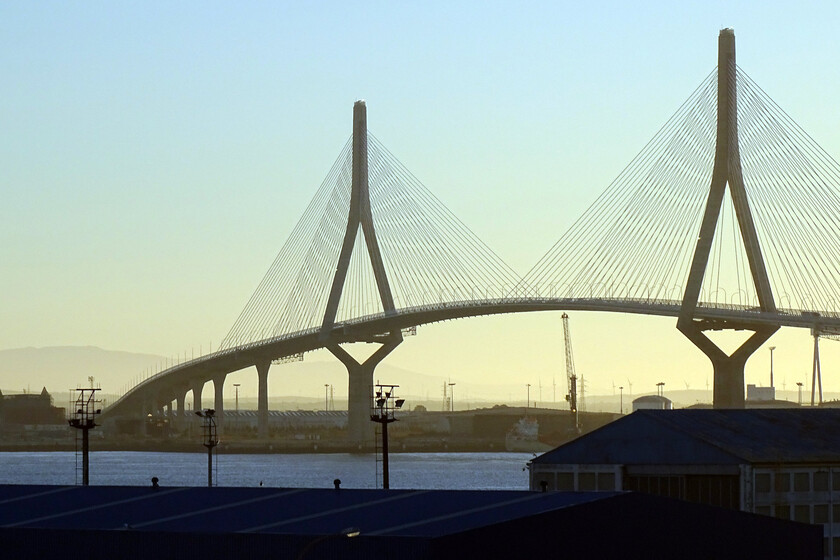
Rubber structural supports. In this new installment of our talks with the Cacesa technical team, we speak with David about one of the most demanding road infrastructure projects in the country: the supply of structural supports for the 1812 Constitution Bridge in Cádiz, a project that challenged the limits of our production capacity due to the colossal size of its components.
The Pepa Bridge in Cádiz: A unique cable-stayed structure
— Let’s talk now about another of the infrastructure projects you’ve built: the Puente de la Pepa in Cádiz, Spain. The Puente de la Pepa is the bridge commemorating the Constitution of 1812. It’s a cable-stayed bridge that crosses the Bay of Cádiz and provides access to the city from the mainland, serving as the third access point. For this bridge—here in Spain it’s easier to understand, we all know where Cádiz is, or it’s easier to locate—what type of structure is it? It’s a bridge, but what solution did you use? Supports? Joints? What did you solve, or what product did you use, to build this Puente de la Pepa in Cádiz?
— Yes, indeed, we worked as suppliers of components for the bridge, but always, as in this case, we also did so through another company, which happens to be the same one we discussed in the previous project. But yes, we focused solely on the structural supports, the pillars, the bridges; we didn’t supply any of the other elements because, well, cable-stayed bridges do have fewer supports than other bridges, and, well, it was a special case that our client was handling, so we simply provided what they requested.
Technical challenges: Manufacturing and vulcanizing 3,500 kg rubber structural supports
— The same question I was asking you: have there been any challenges with this project, any technical problems related to heavy loads or because it’s a cable-stayed bridge, such as lateral movement instead of just weight? Any technical problems that this project presented that you recall or that you see as different from other projects?
— Yes, indeed, on this occasion I was very aware of it, being close to the project and having to manufacture the structural rubber supports. Obviously, there were three of these supports, and they did present a technical challenge in terms of their size; that is, they were enormous supports that we had to adapt a bit to the machinery in order to work with them. I don’t remember the exact dimensions, but I do remember the weight of each support, which was around 3,000 or 3,500 kilos. So we had to handle such a large support, demold it, remove it from the press, and so on; prepare the loads… It was all a very complicated undertaking.
And besides that, being so large, we also had the problem that none of them could go wrong because, of course, if one of those supports came out wrong, the loss was all we could gain; in other words, it was a total loss. Therefore, we had to do it very slowly, positioning the plates very carefully, positioning the rubber very carefully, putting everything together perfectly, knowing exactly what vulcanization time it needed—which we also had no prior knowledge of—and so on. A series of technical challenges that we did manage to overcome, and thanks to, well, the time we’ve spent making the supports, the result was positive; they sold and are working without any problems.
Production capacity: Large format machinery for large parts
— And I’ll say the same to you: why CACESA? Why did they choose your suppliers? If it was, as you said, because of the price, the durability, the ability to manufacture custom-made products, because it complies with international regulations… What is the reason they chose CACESA?
—Well, in this case, the reason was more the characteristics of our machine than the price. So, besides… Our specialty is large pieces, as I mentioned in a previous audio recording. Our machines are large; to make these supports, you need a machine with certain dimensions… I remember the largest one where the supports were made, which is 2 by 2 meters, 2 meters wide and 2 meters long, and then, importantly, it opens a meter or a meter and a half wide. This allows you to insert the support, vulcanize it, work inside, and so on. So, in this case, the client chose us, apart from the price, delivery time, and so on, because the machine’s specifications were suitable for making the support.
Life cycle: Performance and behavior of long-term rubber structural supports
—Well, the bridge’s been built for a while now… Do you know how long it’s been built? It’s been quite a few years, hasn’t it? This bridge must have been around 2008, right? I mean, it’s been… Not quite 20 years, but maybe close. So, it’s a bridge that’s been built for some time now, and I’m asking you the same thing: are the supports working properly? Is the bridge still there? But do you have any kind of follow-up? Has the company, the engineering firm, told you anything? Do you have any contact with them from other projects? I don’t know if they tell you a bit about how the work turned out.
— Well, the truth is, no, we don’t know how they’ve performed… I mean, we know they work because otherwise, they would have told us, because these pieces have a long lifespan, and if they lasted less than that, the client would have let us know right away. But no, we don’t really monitor the work, and it’s true that we dedicate our time to new projects, to improving, and well, we try to do that. One of the most important things for us when it comes to running the company is that it’s essential for the piece we make to last in perfect condition for as long as possible, and with these supports, it’s true that we make a lot of them, and it’s working out well for us.


Leave a Reply
Want to join the discussion?Feel free to contribute!