
The Supply of Supports for Bridges and Viaducts in the Dubai Metro
The Supply of Supports for Bridges and Viaducts in the Dubai Metro
Bridge and viaduct supports. The expansion of transport networks in the United Arab Emirates has demanded the highest level of expertise from industrial component suppliers. In this new interview with David, head of Cacesa, we analyze firsthand the details of the supply and certification of the damping systems used on the Dubai Metro’s Orange Line, a project that consolidates our track record in the international rail sector.
The context of the project: High-speed infrastructure in the United Arab Emirates
To understand the scale of the project, it’s necessary to analyze the type of route this mass transit system follows. Below, Pedro and David detail the physical characteristics of this metro network and how the structural solution was developed in Spain.
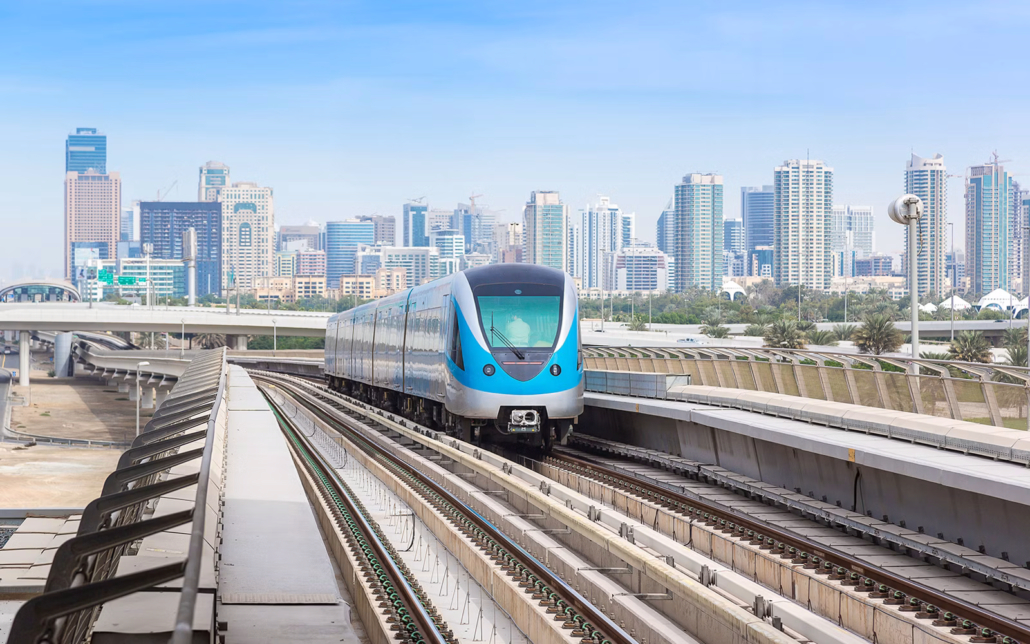
— There’s another metro project you’re working on that I’d like to ask you about now, which is the Orange Line of the Dubai Metro. In the other project, you built a viaduct; here, the metro line itself is also a bridge so the trains run above it. Tell us a little about its exact location and what kind of infrastructure it is.
— Well, as Pedro has already told you, this is the Dubai Metro. I’m not entirely sure if it was a metro line, though; I remember it being the orange line, and it’s somewhat similar to what was done in Doha. They’re elevated bridges, I think I remember a section of them, and that’s where the supports are used to hold up the beams that support the train tracks—the pillars.
The technical solution: Exclusive elastomeric supports for the Dubai Metro
In regions with desert climates, the simplicity and high strength of the materials are key factors in avoiding complex maintenance in the future. This section confirms the unique solution adopted for the bridges on the line.
— In this case it’s the same as the other one, I suppose the solution you’re providing is elastomeric supports and there’s no other material.
— That’s right, what we do in these countries is supply elastomeric bearings for bridges, and yes, they placed the order with us. Again, it was through our engineering firm in Spain, which specialized in these countries and was kind enough to place the orders with us.
The challenge of quality management: Individualized certification
The real challenge of “pharaonic” projects in the Persian Gulf usually lies in the strict levels of control demanded by international organizations and the engineering firms in charge of supervising the work.
— Well, it was a very large order with the technical complications that entails, so in order to guarantee and certify each and every one of the supports we have provided.
Technical analysis: The value of piece-by-piece certification
As David rightly points out in the conversation, the scale of an order for supports for bridges and viaducts intended for a metro network lies not only in the physical volume of vulcanized rubber that is manufactured, but also in the destructive and non-destructive quality control that is applied to each unit.
What does certifying each and every support entail?
To meet engineering deadlines and current regulations, the manufacturing process for bridge and viaduct supports at Cacesa’s facilities must follow very strict automated protocols:
-
Compression tests: Each piece is subjected to simulated loads equivalent to those that the real subway pillars will withstand with the trains at full capacity.
-
Vulcanization control: It is checked that there are no air bubbles or imperfections in the joint between the internal steel plates and the elastomer.
-
Full traceability: Each of the supports for bridges and viaducts leaves our facilities with a unique serial number and its corresponding technical test sheet, something vital for the Spanish engineering team to validate the installation for the end customer in Dubai.
Thanks to this methodological rigor, the components supplied by Cacesa continue to ensure the stability and correct guidance of the rails in the most modern metro lines in the Middle East.


Leave a Reply
Want to join the discussion?Feel free to contribute!