Custom Elastomeric Bearings: Technical Solution for the Puente de la Pepa in Cádiz
Custom Elastomeric Bearings: Technical Solution for the Puente de la Pepa in Cádiz
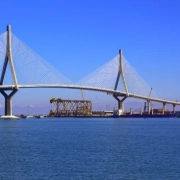
Custom-made elastomeric bearings. The 1812 Constitution Bridge, popularly known as the Puente de la Pepa, is one of Spain’s most complex and spectacular engineering feats. As it is a high-rise cable-stayed bridge spanning the Bay of Cádiz, the selection of structural components was critical.
In this project, the use of large-format custom-made elastomeric bearings proved essential to manage massive loads and ensure the stability of this vital infrastructure that connects the city to the mainland.
The Pepa Bridge and the need for special support
This structure is the third access point to Cádiz and stands out as one of the tallest bridges of its kind in the world. Due to its cable-stayed design, the distribution of stresses differs from that of conventional viaducts. Although this type of bridge requires fewer support points, these must be capable of withstanding extraordinary stresses.
As specialized suppliers, at Cacesa we handled the custom-designed elastomeric bearings specifically for the structure’s pillars. The client, an engineering firm with whom we had already collaborated on international projects, trusted our ability to solve a challenge of extraordinary dimensions.
Challenges in the manufacture of large tonnage parts
The main challenge of this project was not only the chemical composition of the rubber, but also the physical size of the pieces. We are talking about supports that reached a weight of between 3,000 and 3,500 kilos per unit.
1. Handling and precision in vulcanization
Manufacturing custom elastomeric bearings of this weight requires highly sophisticated internal logistics. Because they are such massive blocks of rubber and steel, the vulcanization process is extremely delicate:
-
Heat management: It is necessary to ensure that the vulcanization temperature reaches the core of the part homogeneously without degrading the outer layers.
-
Plate precision: In pieces weighing more than three tons, the manual placement of the vulcanized steel plates must be perfect to avoid deviations in load capacity.
-
Production risk: Due to the cost of materials and the time invested, there was no margin for error; each piece had to be perfect the first time to meet profitability and deadline standards.
2. Large format machinery (2×2 meters)
The reason Cacesa was chosen for this project lies in our production capacity. Manufacturing these custom elastomeric bearings requires presses with dimensions that are not standard on the market:
-
Working surface: We have 2×2 meter machines that can accommodate the gigantic molds needed for the Puente de la Pepa.
-
Opening capacity: Our machinery allows openings of up to one and a half meters, facilitating the demolding and safe handling of 3,500 kilo pieces.
Bridge engineering and compliance with EN 1337 standards
The safety of an infrastructure that supports constant traffic to Cádiz cannot be left to chance. Therefore, all our custom-made elastomeric bearings are manufactured in accordance with the strict EN 1337 standard.
This European regulation guarantees that the structural supports have passed tests of:
-
Compressive strength: Supporting the weight of the deck itself and the dynamic traffic loads.
-
Rotation capacity: Allowing the structure to adapt to movements without generating cracks in the pillars.
-
Durability in marine environments: The rubber is formulated to withstand the salinity and extreme humidity of the Cadiz coast.
Furthermore, the CE marking seal confirms that each unit delivered has passed rigorous quality controls, ensuring a lifespan exceeding several decades of flawless service.
Results after more than a decade of service
The Puente de la Pepa bridge is now a firmly established feature of the Cádiz landscape. After years of operation, the custom-made elastomeric bearings supplied continue to function without any technical issues.
In our philosophy as manufacturers, success is measured by the absence of any customer feedback: if the supports don’t require corrective maintenance before their expected lifespan, the work has been excellent. This project reinforces our specialization in large parts, where technical expertise and the right machinery make the difference between a standard component and a high-level engineered solution.
Conclusion: Leaders in tailored support solutions
Our involvement in the 1812 Constitution Bridge demonstrates that Cacesa is the ideal partner for projects where scale and technical complexity are critical. The supply of custom-made elastomeric bearings for this project is a testament to our ability to tackle monumental challenges with meticulous craftsmanship.